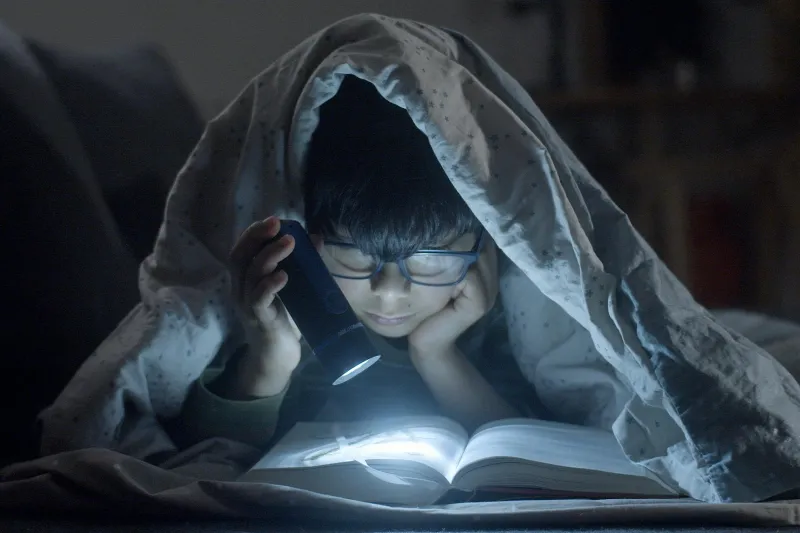
"Turn on a light! You'll ruin your eyes reading in the dark like that."
If you grew up in America, you've heard some version of this warning. Maybe it was your mom hovering over your shoulder as you read under blankets with a flashlight. Maybe it was a teacher catching you squinting at a book during indoor recess.
The message was always the same: reading in dim light causes permanent eye damage. It's a belief so widespread that it's shaped everything from bedroom lighting design to study habits. There's just one problem — it's not true.
What Eye Doctors Actually Know
Ophthalmologists have been trying to correct this misconception for decades. The American Academy of Ophthalmology is unambiguous: "Reading in dim light does not damage your eyes." The College of Optometrists in the UK echoes this position. So does virtually every major eye care organization worldwide.
Dr. Rahul Khurana, a clinical spokesperson for the American Academy of Ophthalmology, puts it simply: "There is no evidence that reading in dim light causes permanent eye damage."
So what actually happens when you read in low light? Your eyes work harder. The muscles controlling your iris and lens strain to gather more light and maintain focus. You might experience temporary discomfort — dry eyes, headaches, blurred vision. But these symptoms resolve completely once you rest your eyes or improve the lighting.
It's the difference between your legs feeling tired after a long walk versus actually injuring your legs. Temporary fatigue isn't permanent damage.
The Myth That Wouldn't Die
If eye doctors have known this for so long, why do so many parents still believe the opposite? The answer lies in how effectively this particular myth spread through American culture — and why it felt so believable.
First, there's the immediate cause-and-effect that parents could observe. Kids reading in dim light did complain about eye strain, headaches, and difficulty seeing. The discomfort was real, even if the long-term damage wasn't.
Second, the warning aligned perfectly with broader cultural anxieties about children's health and modern technology. As electric lighting became standard in American homes during the early 20th century, parents worried about everything from radio waves to artificial light affecting their children's development.
The Perfect Storm of Parental Anxiety
The myth gained traction during an era when childhood myopia (nearsightedness) rates were climbing in developed countries. Parents naturally looked for explanations, and "too much close-up work in poor lighting" seemed logical.
This created a classic case of correlation being mistaken for causation. Kids were indeed becoming more nearsighted, and many did spend time reading in less-than-ideal lighting conditions. The connection seemed obvious, even though research would later show that myopia development is primarily driven by genetics and spending too much time indoors — not lighting conditions during reading.
How the Lamp Industry Helped
The belief got an unexpected boost from an unlikely source: the lighting industry. Manufacturers of desk lamps, reading lights, and specialized task lighting had every incentive to promote the idea that proper illumination was crucial for eye health.
Advertisements from the 1950s and 60s routinely featured warnings about eye strain and the importance of "proper lighting for reading." These weren't necessarily malicious campaigns, but they reinforced existing parental concerns while conveniently offering a solution for purchase.
What Really Affects Long-Term Eye Health
While reading in dim light won't damage your vision, several factors actually do affect long-term eye health:
Genetics play the biggest role in determining whether you'll develop myopia, and how severely. If both parents are nearsighted, their children have roughly a 50% chance of developing myopia regardless of reading habits.
Time spent outdoors appears protective against myopia development in children. Multiple studies suggest that natural light exposure and focusing on distant objects help maintain healthy vision development.
UV exposure can damage the retina and increase cataract risk over time. This is why sunglasses matter more than reading lamps for long-term eye health.
Digital screen use can cause eye strain and may contribute to dry eye syndrome, but current research suggests it doesn't cause permanent damage either.
The Comfort Factor
None of this means you should deliberately read in poor lighting. While it won't damage your eyes, adequate lighting simply makes reading more comfortable and efficient. You'll read faster, comprehend better, and feel less fatigued with proper illumination.
The ideal reading light provides even, non-glaring illumination that eliminates harsh shadows on the page. But this is about comfort and performance, not preventing eye damage.
Why This Myth Matters
The dim light eye damage myth illustrates how health misinformation spreads and persists, even in the face of clear scientific evidence. It combines several powerful elements:
- Observable short-term effects (eye strain) that seem to support the claim
- Parental protective instincts
- Commercial interests that benefit from the belief
- Intuitive logic that "feels" correct
These same patterns appear in many persistent health myths, from the idea that cracking knuckles causes arthritis to the belief that you lose most body heat through your head.
The Real Takeaway
Your eyes are remarkably resilient organs, designed to function across a wide range of lighting conditions. While reading in dim light might make you squint and feel uncomfortable, it's not silently destroying your vision.
The next time you catch yourself reaching for a brighter lamp "to protect your eyes," remember you're really just making reading more pleasant — which is reason enough. Sometimes the truth is simpler than the myth, and that's perfectly fine.
Your childhood flashlight reading sessions didn't doom you to a lifetime of vision problems. They just made you temporarily tired, and probably gave you some great memories of late-night adventures with your favorite books.